Periodontist vs General Dentist
Both professionals care for your mouth, but they do different kinds of work. A general dentist handles routine dental care, while a periodontist focuses on gums, bone, and tooth support.
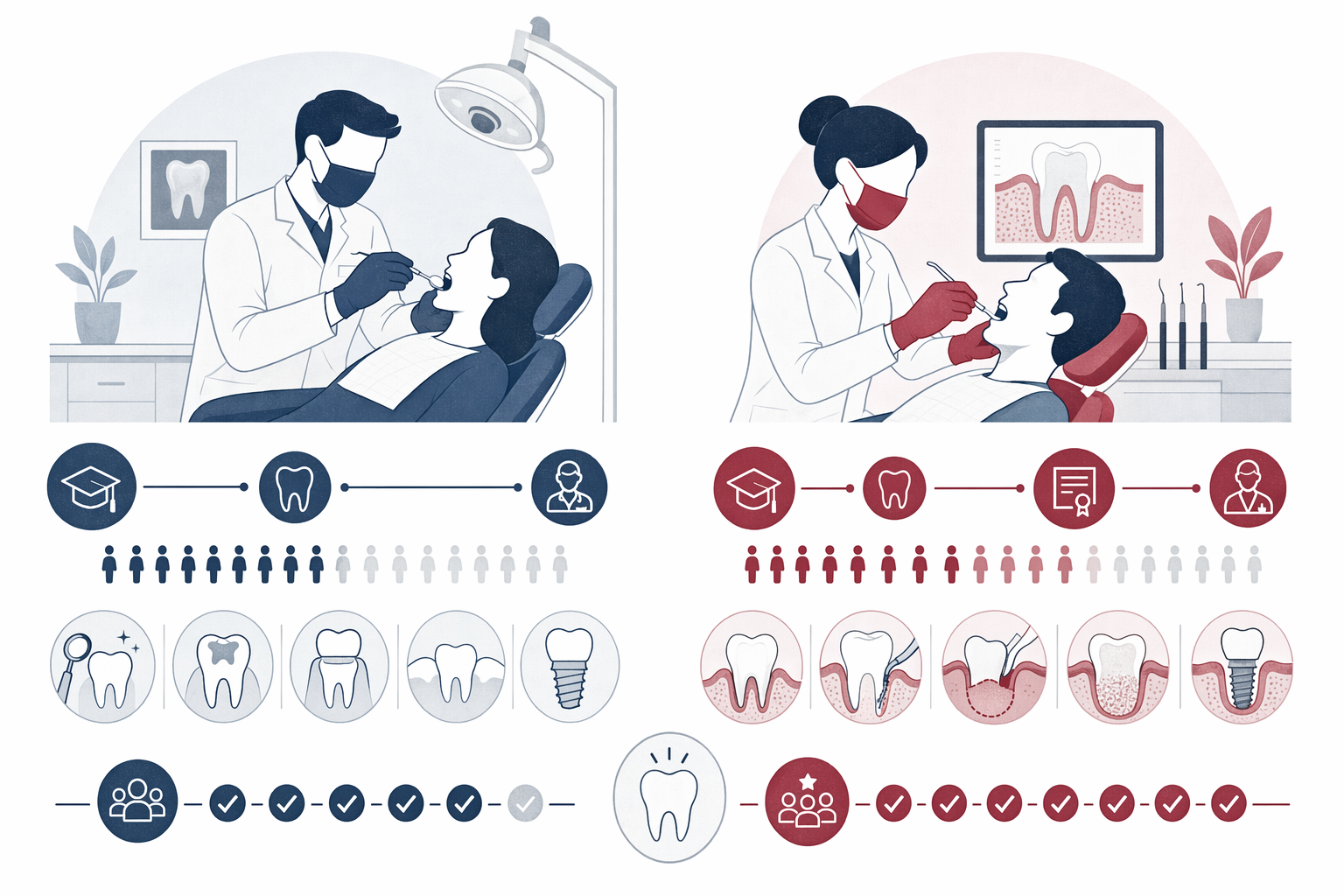
What is the difference?
A general dentist is usually the first stop for regular dental care. They check teeth and gums, take routine X-rays, do cleanings, place fillings, and may notice signs of gum problems during an exam.
A periodontist is a licensed dentist with extra training in gum disease, gum recession, bone loss around teeth, and surgical procedures that support teeth or replace missing teeth. If gum problems are more advanced, complex, or not improving, a general dentist may refer you to a periodontist.
Here is the simple comparison:
- General dentist: routine exams, preventive care, common dental problems, early gum concerns
- Periodontist: deeper evaluation of gum and bone support, advanced gum disease care, gum grafts, periodontal surgery, and many implant-related procedures
- Both: can play an important role, and many people see both at different times
If you want a fuller overview of what a specialist does, see what is a periodontist.
Important: This page is general education only. RootLine is a free matching service, not a dental provider. Only a licensed dentist or periodontist can diagnose your condition after an in-person exam.
Side-by-side comparison
Use this quick guide to understand who usually handles what:
1. Routine checkups and regular cleanings
Usually a general dentist or dental hygienist in a general dental office.
2. Early signs of gum irritation like bleeding when brushing
Often starts with a general dentist, who may recommend better cleaning habits or further evaluation.
3. Possible moderate or advanced gum disease
A periodontist may be the better fit for diagnosis and treatment planning, especially if there is deeper infection, gum recession, loose teeth, or bone loss.
4. Deep cleaning (scaling and root planing)
Some general dentists provide this. Periodontists also provide it, especially in more involved cases. Learn more about deep cleaning and scaling.
5. Gum grafts for recession or exposed roots
Usually a periodontist.
6. Pocket-reduction or flap surgery
Usually a periodontist.
7. Dental implants
This can involve different professionals, but many periodontists place implants and manage the gum and bone side of care.
8. Long-term periodontal maintenance after gum treatment
Often shared between a general dentist and a periodontist, depending on your needs and the provider's plan.
There is not always a hard line. Some general dentists provide more gum care than others. The right choice depends on the diagnosis, how severe the problem is, and what services a local provider offers.
When a periodontist may be the better next step
A general dentist is still the right place for many people. But it can make sense to see a periodontist if you have concerns like these:
- gums that often bleed, even after improving home care
- gums pulling away from teeth
- teeth that feel loose or seem to be shifting
- repeated gum infections or bad taste in the mouth
- deep gum pockets mentioned by a dentist
- bone loss seen on dental X-rays
- you were told you may need gum surgery, a gum graft, or implant-related care
A periodontist has extra training in the structures that hold teeth in place: gums, connective tissue, and bone. That matters when the problem is not just on the tooth surface.
This does not mean you should skip your general dentist. In many cases, the best care is coordinated care. Your general dentist may spot the issue first, and the periodontist may handle the specialist part.
If you are not sure how serious gum disease can become over time, read stages of gum disease.
Safety note: If you have severe pain, facial swelling, fever, or trouble breathing or swallowing, seek urgent dental or medical care right away.
What about cost?
Costs depend on the diagnosis, the number of teeth or areas treated, the provider, insurance, and where you live. These are typical US ranges only, not quotes:
- Deep cleaning (scaling and root planing): about $150-$400 per quadrant
- Gum graft: about $600-$1,200 per site
- Periodontal flap or pocket-reduction surgery: about $1,000-$3,000 per area
- Bone graft: about $300-$1,200
- Routine periodontal maintenance: about $115-$300 per visit
- Dental implant: often $3,000-$6,000 per tooth all-in over time
A general dental office may charge differently from a periodontal office, but price alone does not tell you which provider is the best fit. The real question is: what kind of care do you actually need? A lower price for the wrong service is not a good value.
Before agreeing to treatment, ask for:
- the exact name of the recommended procedure
- how many teeth, sites, or areas are involved
- whether there are lower-cost or staged options
- what your insurance may help cover
- what follow-up visits may cost
You can also review gum treatment costs and check does insurance cover gum treatment for general guidance.
How to choose the right provider for you
If you are deciding between starting with a general dentist or seeing a periodontist, this simple process can help:
1. Start with your main concern.
Is it a routine cleaning, tooth pain, bleeding gums, receding gums, loose teeth, or a missing tooth?
2. Think about complexity.
Routine care usually starts with a general dentist. Gum recession, bone loss, surgery, or implant planning often point toward a periodontist.
3. Ask clear questions.
Good examples are: What do you think is causing this? Do I need a specialist? What are my options? What are the likely costs? You can use this guide to questions to ask a periodontist.
4. Compare before you commit.
You choose who to see. You confirm the plan and price with the provider before any treatment.
RootLine can help you get started. We are a free matching service for people across the US, including new immigrants and non-native English speakers. We do not diagnose, examine, or provide care. We help you compare licensed periodontists. Our form asks for contact and request details only, not a medical history. If you want to explore specialist options, you can get matched.
A general dentist handles regular dental care. A periodontist is a gum specialist with extra training in gums, bone, and more advanced gum treatment. If your concern seems more serious or you were told you may need specialist care, compare your options and confirm the plan and cost with a licensed provider.