Deep cleaning — scaling & root planing
Deep cleaning, also called **scaling and root planing**, is a common non-surgical treatment that a licensed dentist or periodontist may recommend when gum disease affects the tissue below the gumline. This page explains the basics in plain language so you can ask better questions and compare your options.
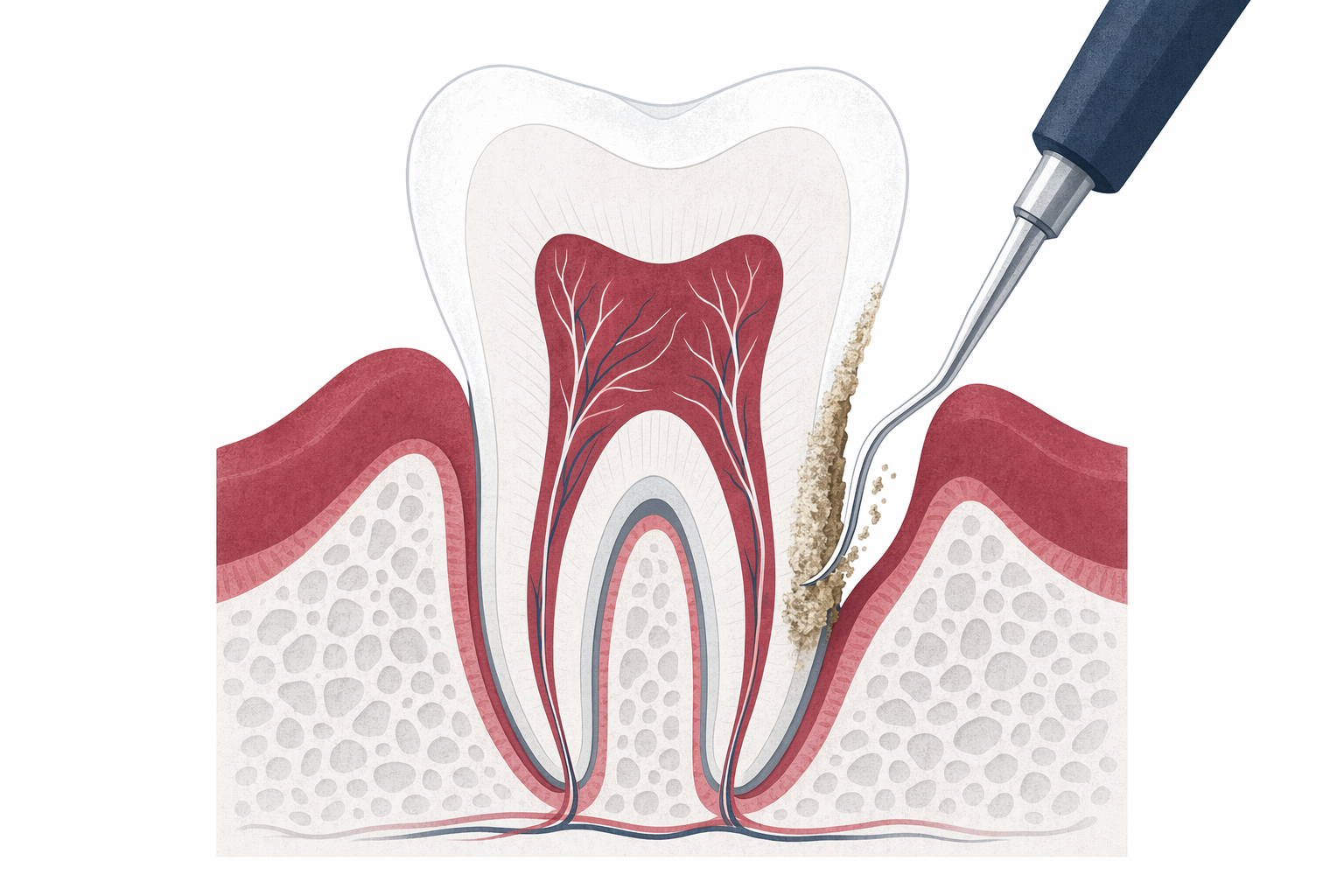
What deep cleaning is
A regular dental cleaning removes plaque and tartar from the visible tooth surfaces. A deep cleaning goes farther. It cleans below the gumline and along the root surfaces, where bacteria and hardened buildup can collect when gums are inflamed.
The goal is to reduce irritation and give the gums a better chance to reattach more closely around the teeth. It is often discussed for people with gum disease, also called periodontal disease, but only a licensed dentist or periodontist can tell you what is appropriate after an in-person exam.
Deep cleaning is not the same as a diagnosis. It is one possible treatment approach. Some people may need only improved home care and routine cleanings. Others may need periodontal maintenance or additional care over time. You can learn more about gum disease basics here: gum disease treatment and stages of gum disease.
If you have severe pain, facial swelling, fever, or trouble breathing or swallowing, seek urgent dental or medical care right away.
How scaling and root planing usually works
The exact process depends on the provider and what they find during your exam, but many appointments follow a pattern like this:
1. Evaluation and treatment plan
The provider examines your gums and teeth, may measure pocket depths, and may use dental X-rays if needed. They explain whether scaling and root planing is being recommended and which areas are involved.
2. Numbing the area
Many providers use local anesthetic so the treated area is more comfortable during the visit. Ask what to expect in your case.
3. Scaling
The provider removes plaque and tartar from above and below the gumline. Hand instruments, ultrasonic tools, or both may be used.
4. Root planing
The root surfaces are smoothed to help reduce places where bacteria can stick and to support healing.
5. Follow-up
The provider may want to recheck the gums after several weeks to see how the tissue responded and whether more care is needed.
Treatment is often done by quadrant, meaning one quarter of the mouth at a time, or in two larger halves. Many people do not have the whole mouth treated in one visit. Your provider can explain the schedule, how long each visit may take, and what kind of follow-up is typical.
For a broader overview, see what a periodontist does.
Typical cost in the US
Deep cleaning costs vary a lot. A typical US estimate is about $150 to $400 per quadrant for scaling and root planing.
That is an estimate, not a quote. The real price depends on:
- how many quadrants or areas need treatment
- how much buildup is present
- the diagnosis and pocket depths
- whether X-rays, numbing, or follow-up visits are included
- the provider's office and your local area
- your dental insurance benefits, waiting periods, and annual maximums
Example: if treatment is recommended in four quadrants, the total may be much more than a single-quadrant estimate. Some offices also recommend ongoing periodontal maintenance after deep cleaning. Routine periodontal maintenance often falls around $115 to $300 per visit, but the actual amount depends on the office, insurance, and region.
Coverage varies. Some dental plans help with scaling and root planing when it is medically necessary under the plan terms, while others cover less than people expect. Before scheduling, ask for a written estimate and confirm what your plan may pay. Our costs guide and insurance guide can help you prepare the right questions.
You stay in control: you compare, you choose who to see, and you confirm the plan and price with the provider before any treatment.
Recovery, aftercare, and timeline
Recovery is usually manageable, but every mouth is different. Many people notice some tenderness, sensitivity, or minor gum soreness for a short time after treatment, especially with cold foods or brushing near recently treated areas. Your provider can tell you what is typical for your case and what type of home care they want you to follow.
A few common points:
- Gums may feel tender for a few days.
- Teeth may feel more sensitive than usual for a while.
- The provider may ask you to brush gently and keep the area clean.
- Follow-up matters. The gums are often rechecked after healing time to see how they responded.
The timeline is not the same for everyone. Some people complete treatment in one or two visits. Others need more appointments, especially if several areas are involved. Improvement in inflammation can take time, and some people still need ongoing maintenance or other periodontal treatment later.
It is important not to judge the result too quickly. Only the examining provider can tell you whether the gums are responding as hoped.
Call the dental office promptly if symptoms seem worse than expected. And again, if you develop facial swelling, fever, severe pain, or trouble breathing or swallowing, seek urgent dental or medical care right away.
Pros, limits, and when more treatment may be discussed
Deep cleaning can be helpful, but it is not a magic fix. It has potential benefits and real limits.
Possible benefits
- Removes plaque and tartar below the gumline
- May reduce gum inflammation and bleeding
- May help some pockets become easier to keep clean
- Non-surgical first step for many people with periodontal disease
Limits to understand
- It does not guarantee that gum disease will stop or reverse
- Some teeth or areas may not respond enough with deep cleaning alone
- Ongoing home care and follow-up visits are often important
- Some people may later be told they need additional care such as gum surgery, grafting, or treatment for tooth loss
If deeper pockets, gum recession, bone loss, or loose teeth are present, the provider may discuss other services depending on the diagnosis. Those can include periodontal surgery, gum grafts, or replacement options such as dental implants if a tooth is lost. That does not mean you will need those treatments. It simply means deep cleaning is one part of a bigger conversation about gum health.
Questions to ask before you schedule
Bring a short list of questions so you can compare providers clearly. Plain questions are fine.
- Why are you recommending scaling and root planing for me?
- How many quadrants or areas would be treated?
- Will you use local anesthetic? What should I expect during the visit?
- What is the estimated total cost before insurance and after insurance, if known?
- Does the estimate include X-rays, follow-up checks, and maintenance visits?
- How many appointments will I likely need?
- What kind of recovery is typical, and when should I call if something feels wrong?
- If deep cleaning does not improve the gums enough, what are the next possible steps?
These questions do not ask for a medical history on a matching form. They are questions to ask the licensed provider directly during your consultation. You can also use this checklist: questions to ask a periodontist.
How RootLine helps you find a periodontist
RootLine is a free matching service. We are not a dental office, periodontist, or medical provider. We do not diagnose, examine, or treat gum disease, and the information here is general education only.
If you want help finding a licensed periodontist, you can use our free matching service. The form asks for contact and general request details only so providers can reach you. It does not ask for a medical or dental history.
Why people use RootLine:
- Free to use
- Help for people across the US
- Multilingual support for many non-native English speakers and new immigrants
- You can compare options and decide who to contact
When you are ready, start here: get matched.
Remember: you choose who to see, and you confirm the treatment plan and costs directly with the provider before moving forward.
Deep cleaning is a below-the-gum cleaning that a licensed dentist or periodontist may recommend for gum disease. It usually costs about $150 to $400 per quadrant, recovery is often mild but varies, and the only way to know if you need it is to get an in-person exam by a licensed provider.